Posted on

Linux System Programming, 2nd Edition

Copyright 2013 Robert Love

ISBN: 978-1-449-33953-1

Write software that draws directly on services offered by the Linux kernel and core system libraries. With this comprehensive book, Linux kernel contributor Robert Love provides you with a tutorial on Linux system programming, a reference manual on Linux system calls, and an insider’s guide to writing smarter, faster code.

Love clearly distinguishes between POSIX standard functions and special services offered only by Linux. With a new chapter on multithreading, this updated and expanded edition provides an in-depth look at Linux from both a theoretical and applied perspective over a wide range of programming topics, including:

  • A Linux kernel, C library, and C compiler overview
  • Basic I/O operations, such as reading from and writing to files
  • Advanced I/O interfaces, memory mappings, and optimization techniques
  • The family of system calls for basic process management
  • Advanced process management, including real-time processes
  • Thread concepts, multithreaded programming, and Pthreads
  • File and directory management
  • Interfaces for allocating memory and optimizing memory access
  • Basic and advanced signal interfaces, and their role on the system
  • Clock management, including POSIX clocks and high-resolution timers
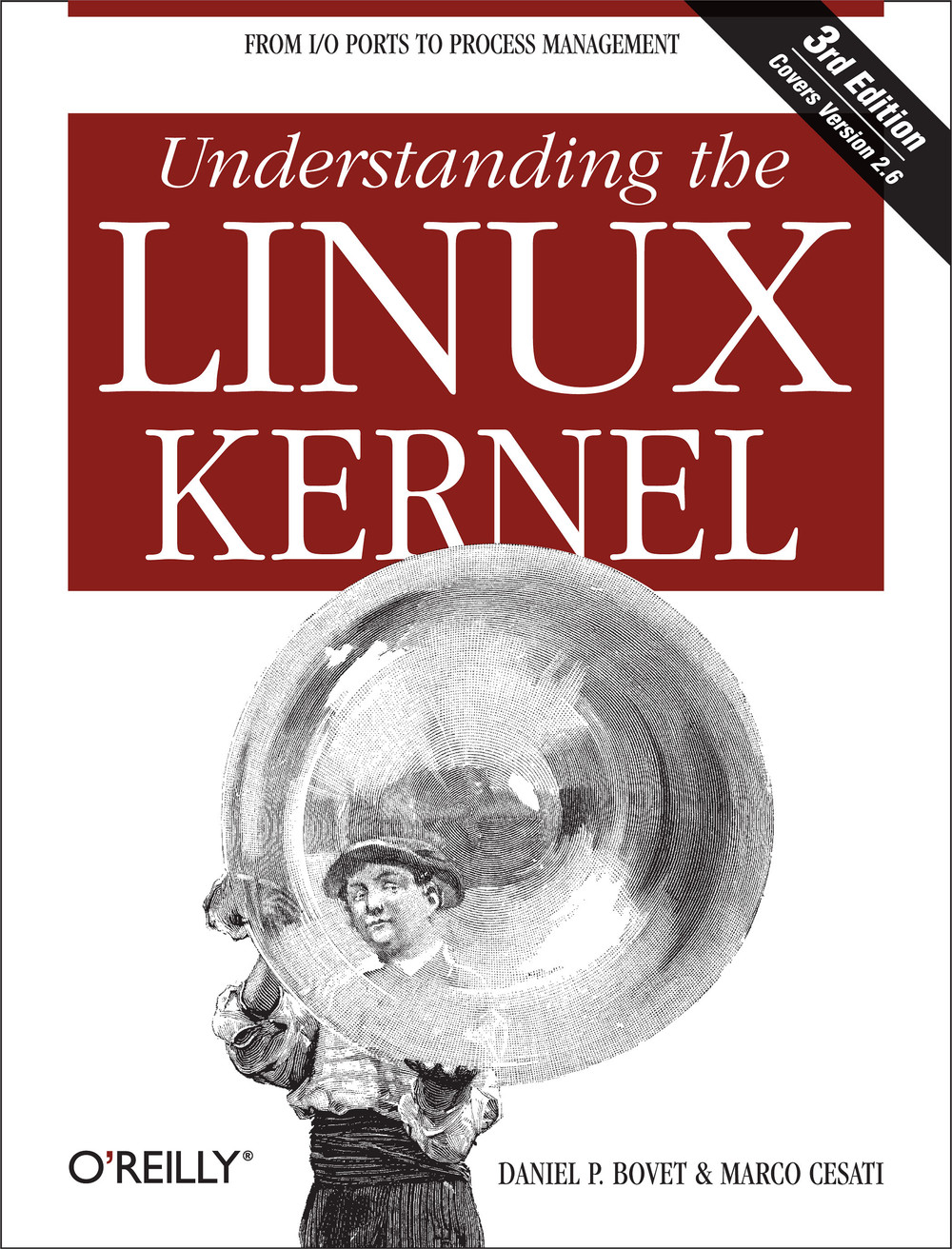
Posted on

Understanding the Linux Kernel, 3rd Edition

Copyright © 2008 O’Reilly Media, Inc.

In order to thoroughly understand what makes Linux tick and why it works so well on a wide variety of systems, you need to delve deep into the heart of the kernel. The kernel handles all interactions between the CPU and the external world, and determines which programs will share processor time, in what order. It manages limited memory so well that hundreds of processes can share the system efficiently, and expertly organizes data transfers so that the CPU isn’t kept waiting any longer than necessary for the relatively slow disks.

The third edition of Understanding the Linux Kernel takes you on a guided tour of the most significant data structures, algorithms, and programming tricks used in the kernel. Probing beyond superficial features, the authors offer valuable insights to people who want to know how things really work inside their machine. Important Intel-specific features are discussed. Relevant segments of code are dissected line by line. But the book covers more than just the functioning of the code; it explains the theoretical underpinnings of why Linux does things the way it does.

This edition of the book covers Version 2.6, which has seen significant changes to nearly every kernel subsystem, particularly in the areas of memory management and block devices. The book focuses on the following topics:

  • Memory management, including file buffering, process swapping, and Direct memory Access (DMA)
  • The Virtual Filesystem layer and the Second and Third Extended Filesystems
  • Process creation and scheduling
  • Signals, interrupts, and the essential interfaces to device drivers
  • Timing
  • Synchronization within the kernel
  • Interprocess Communication (IPC)
  • Program execution

Understanding the Linux Kernel will acquaint you with all the inner workings of Linux, but it’s more than just an academic exercise. You’ll learn what conditions bring out Linux’s best performance, and you’ll see how it meets the challenge of providing good system response during process scheduling, file access, and memory management in a wide variety of environments. This book will help you make the most of your Linux system.

Posted on

Git Pocket Guide

Copyright 2013 Richard Silverman

ISBN: 978-1-449-32586-2

This pocket guide is the perfect on-the-job companion to Git, the distributed version control system. It provides a compact, readable introduction to Git for new users, as well as a reference to common commands and procedures for those of you with Git experience.

Written for Git version 1.8.2, this handy task-oriented guide is organized around the basic version control functions you need, such as making commits, fixing mistakes, merging, and searching history.

  • Examine the state of your project at earlier points in time
  • Learn the basics of creating and making changes to a repository
  • Create branches so many people can work on a project simultaneously
  • Merge branches and reconcile the changes among them
  • Clone an existing repository and share changes with push/pull commands
  • Examine and change your repositoryâ??s commit history
  • Access remote repositories, using different network protocols
  • Get recipes for accomplishing a variety of common tasks
Posted on

Git for Teams

Copyright © 2015 Johannes Shindelin. All rights reserved.

ISBN: 978-1-491-91118-1

[Extra] http://gitforteams.com/

You can do more with Git than just build software. This practical guide delivers a unique people-first approach to version control that also explains how using Git as a focal point can help your team work better together. You’ll learn how to plan and pursue a Git workflow that not only ensures that you accomplish project goals, but also fits the immediate needs and future growth of your team.

The first part of the book on structuring workflow is useful for project managers, technical team leads, and CTOs. The second part provides hands-on exercises to help developers gain a better understanding of Git commands.

Posted on

Linux Observability with BPF

Copyright © 2020 David Calavera and Lorenzo Fontana. All rights reserved.

ISBN 978-1-492-05020-9

[Extra] https://oreil.ly/lbpf-repo

Build your expertise in the BPF virtual machine in the Linux kernel with this practical guide for systems engineers. You’ll not only dive into the BPF program lifecycle but also learn to write applications that observe and modify the kernel’s behavior; inject code to monitor, trace, and securely observe events in the kernel; and more.

Authors David Calavera and Lorenzo Fontana help you harness the power of BPF to make any computing system more observable. Familiarize yourself with the essential concepts you’ll use on a day-to-day basis and augment your knowledge about performance optimization, networking, and security. Then see how it all comes together with code examples in C, Go, and Python.

  • Write applications that use BPF to observe and modify the Linux kernel’s behavior on demand
  • Inject code to monitor, trace, and observe events in the kernel in a secure way—no need to recompile the kernel or reboot the system
  • Explore code examples in C, Go, and Python
  • Gain a more thorough understanding of the BPF program lifecycle