Posted on

Learning Git

Copyright © 2023 Anna Skoulikari. All rights reserved.

ISBN: 978-1-098-13391-7

[GitHub] https://github.com/gitlearningjourney/learning-git

This book teaches Git in a simple, visual, and tangible manner so that you can build a solid mental model of how Git version control works. Through the use of color, storytelling, and hands-on exercises, you will learn to use this tool with confidence.

The information is introduced incrementally so that you don’t get bogged down with unknown terms or concepts. Learning Git is ideal for anyone who needs to use Git for personal or professional projects: coding bootcamp students, junior developers, data professionals, and technical writers, to name just a few!

This book covers how to:

  • Download Git and initialize a local repository
  • Add files to the staging area and make commits
  • Create, switch, and delete branches
  • Merge and rebase branches
  • Work with remote repositories including cloning, pushing, pulling, and fetching
  • Use pull requests to collaborate with others
Posted on

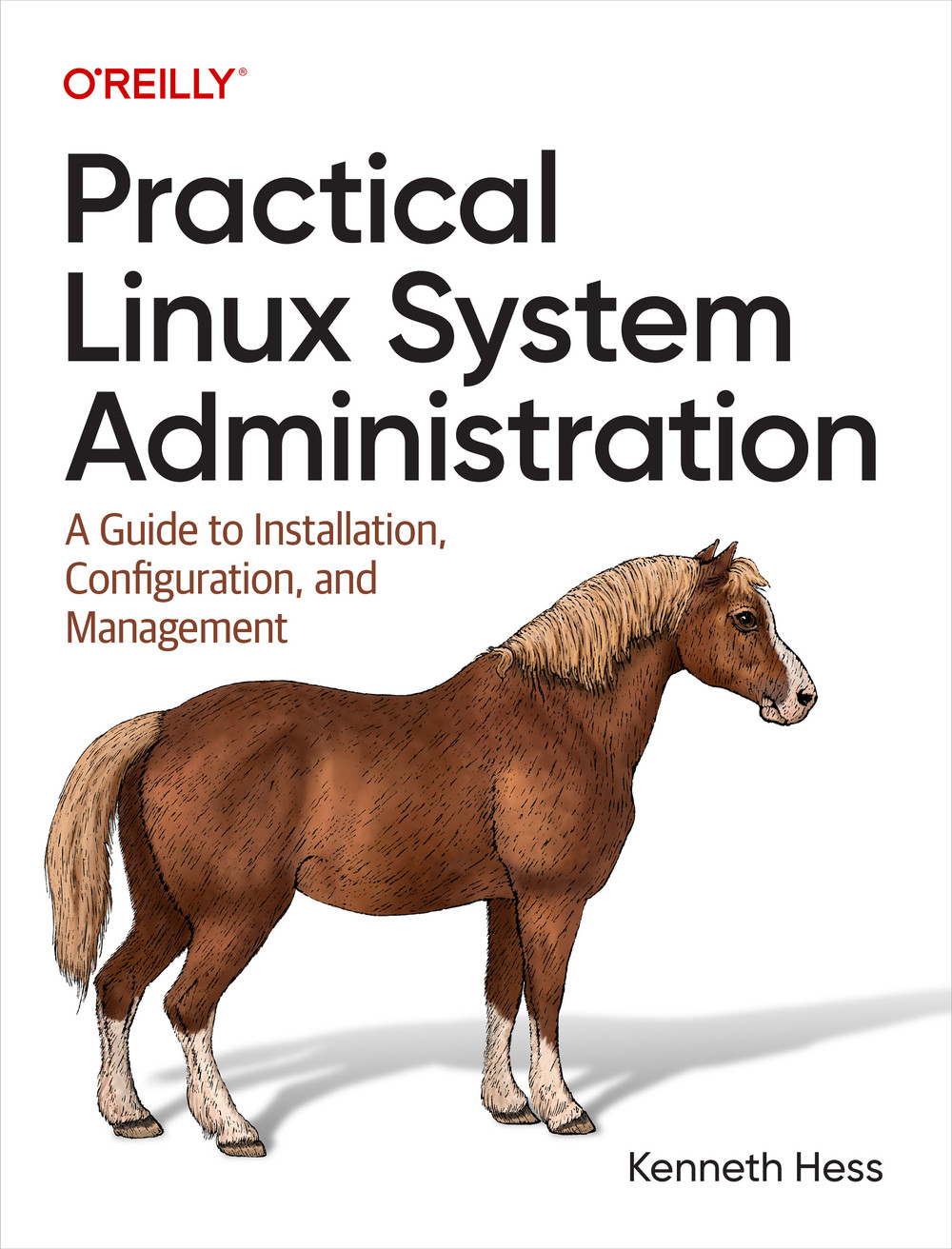
Practical Linux System Administration

Copyright © 2023 Hess Media and Consulting, LLC. All rights reserved.

ISBN: 978-1-098-10903-5

[GitHub] https://github.com/kenhess/practical_linux_administration

This essential guide covers all aspects of Linux system administration, from user maintenance, backups, filesystem housekeeping, storage management, and network setup to hardware and software troubleshooting and some application management. It’s both a practical daily reference manual for sysadmins and IT pros and a handy study guide for those taking Linux certification exams.

You’ll turn to it frequently, not only because of the sheer volume of valuable information it provides but because of the real-world examples within and the clear, useful way the information is presented. With this book at your side, you’ll be able to:

  • Install Linux and perform initial setup duties, such as connecting to a network
  • Navigate the Linux filesystem via the command line
  • Install software from repositories and source and satisfy dependencies
  • Set permissions on files and directories
  • Create, modify, and remove user accounts
  • Set up networking
  • Format and mount filesystems
  • Perform basic troubleshooting on hardware and software
  • Create and manage logical volumes
  • Work with SELinux
  • Manage a firewall and iptables
  • Shut down, reboot, and recover a system
  • Perform backups and restores
Posted on

Version Control with Git, 3rd Edition

Copyright © 2023 Prem Kumar Ponuthorai. All rights reserved.

ISBN 978-1-492-09119-6

Track, branch, merge, and manage code revisions with Git, the free and open source distributed version control system. Through a series of step-by-step tutorials, this practical guide quickly takes you from Git fundamentals to advanced techniques, and provides friendly yet rigorous advice for navigating Git’s many functions. You’ll learn how to work with everything from small to very large projects with speed and efficiency.

In this third edition, authors Prem Kumar Ponuthorai and Jon Loeliger break down Git concepts using a modular approach. You’ll start with the basics and fundamental philosophy of Git, followed by intermediate commands to help you efficiently supplement your daily development workflow. Finally, you’ll learn advanced Git commands and concepts to understand how Git works under the hood.

  • Learn how to use Git for real-world development scenarios
  • Gain insight into Git’s common use cases, initial tasks, and basic functions
  • Use the system for distributed version control
  • Learn how to manage merges, conflicts, patches, and diffs
  • Apply advanced techniques such as rebasing, hooks, and ways to handle submodules
Posted on

Understanding the Linux Kernel, 3rd Edition

Copyright © 2008 O’Reilly Media, Inc.

In order to thoroughly understand what makes Linux tick and why it works so well on a wide variety of systems, you need to delve deep into the heart of the kernel. The kernel handles all interactions between the CPU and the external world, and determines which programs will share processor time, in what order. It manages limited memory so well that hundreds of processes can share the system efficiently, and expertly organizes data transfers so that the CPU isn’t kept waiting any longer than necessary for the relatively slow disks.

The third edition of Understanding the Linux Kernel takes you on a guided tour of the most significant data structures, algorithms, and programming tricks used in the kernel. Probing beyond superficial features, the authors offer valuable insights to people who want to know how things really work inside their machine. Important Intel-specific features are discussed. Relevant segments of code are dissected line by line. But the book covers more than just the functioning of the code; it explains the theoretical underpinnings of why Linux does things the way it does.

This edition of the book covers Version 2.6, which has seen significant changes to nearly every kernel subsystem, particularly in the areas of memory management and block devices. The book focuses on the following topics:

  • Memory management, including file buffering, process swapping, and Direct memory Access (DMA)
  • The Virtual Filesystem layer and the Second and Third Extended Filesystems
  • Process creation and scheduling
  • Signals, interrupts, and the essential interfaces to device drivers
  • Timing
  • Synchronization within the kernel
  • Interprocess Communication (IPC)
  • Program execution

Understanding the Linux Kernel will acquaint you with all the inner workings of Linux, but it’s more than just an academic exercise. You’ll learn what conditions bring out Linux’s best performance, and you’ll see how it meets the challenge of providing good system response during process scheduling, file access, and memory management in a wide variety of environments. This book will help you make the most of your Linux system.
Posted on

Git Pocket Guide

Copyright 2013 Richard Silverman

ISBN: 978-1-449-32586-2

This pocket guide is the perfect on-the-job companion to Git, the distributed version control system. It provides a compact, readable introduction to Git for new users, as well as a reference to common commands and procedures for those of you with Git experience.

Written for Git version 1.8.2, this handy task-oriented guide is organized around the basic version control functions you need, such as making commits, fixing mistakes, merging, and searching history.

  • Examine the state of your project at earlier points in time
  • Learn the basics of creating and making changes to a repository
  • Create branches so many people can work on a project simultaneously
  • Merge branches and reconcile the changes among them
  • Clone an existing repository and share changes with push/pull commands
  • Examine and change your repositoryâ??s commit history
  • Access remote repositories, using different network protocols
  • Get recipes for accomplishing a variety of common tasks